
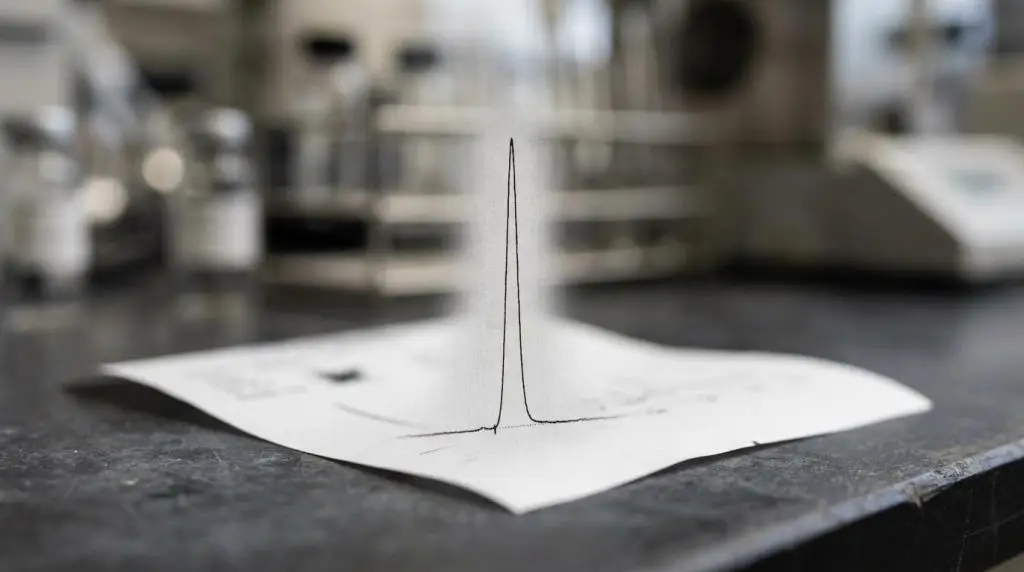
Peptide testing is where marketing claims stop and usable evidence starts. If a lab is buying research peptides, the real question is not whether a supplier says “high purity,” but whether the batch data shows identity, purity, and impurity visibility in a way a scientist can audit.
TL;DR: Summary
- Strong peptide testing means batch-specific third-party analysis plus a downloadable Certificate of Analysis that shows actual results for HPLC, mass spectrometry, and key release details.
- A peptide purity claim by itself is incomplete because purity is not the same as identity, and neither one explains the impurity profile.
- FDA guidance is a useful benchmark for documentation quality: a COA should include the batch number, release date, tests performed, acceptance limits, and numerical results.
- HPLC helps estimate purity by separating peaks, while mass spectrometry helps confirm the expected molecular mass; together they answer different quality questions.
- For synthetic peptides, sensitive methods such as UHPLC-HRMS may be needed when impurity characterization has to go deeper, especially when low-level related impurities matter.
- For research buyers, the practical screen is simple: verify the batch number, read the chromatogram, check whether the COA is batch-specific, and confirm that impurity data is visible rather than implied.
That distinction matters even more in research-use-only purchasing, where buyers still need drug-quality habits even when the material is not a finished pharmaceutical product. The safest approach is to treat peptide testing like a documentation problem and an analytical chemistry problem at the same time.
What does peptide purity mean in peptide testing?
Peptide purity is a quantitative analytical result, not a marketing adjective. HPLC estimates the proportion of the target peptide, and mass spectrometry helps confirm the expected molecular mass.
In practice, purity usually refers to the percentage of the sample represented by the desired peptide peak under a stated chromatographic method. That sounds straightforward, but a common mistake is assuming that one purity number answers every quality question. It does not. A peptide can show a strong main peak and still contain related impurities, truncated sequences, oxidation products, or residual synthesis byproducts that matter for assay performance.
Identity, purity, strength, and impurity profile are connected but not interchangeable. USP materials on synthetic peptide quality point to reference standards and chromatography as central tools for confirming what the peptide is, how clean it is, and whether content or impurity behavior looks acceptable.
Why isn’t a high purity claim enough without third-party testing?
A purity percentage alone is incomplete. FDA documentation expectations and common lab SOPs both favor batch-specific test results, not generic claims on a product page.
Third-party testing matters because it separates the supplier’s commercial claim from an independently generated analytical record. If a vendor says a peptide is 99% or 99.9% pure, the next question should be: according to which batch, which method, and which lab? Without that chain, the number is mostly a label. With it, the number becomes auditable.
“Nationwide Peptides pairs 99%+ purity standards with third-party testing by accredited labs, which gives research buyers both a claim and an independent check.”
There is also a misconception that third-party testing replaces in-house QC. It does not. Internal testing supports process control, while independent testing helps buyers trust the release data. For research procurement, that outside confirmation often becomes the deciding factor when multiple suppliers make similar purity claims.
What are the most important peptide testing facts to verify before you buy?
The best early check is documentation depth. FDA-style COA elements, third-party data, and impurity visibility tell you more than a headline purity number.
Before ordering, buyers should verify a few non-negotiables rather than comparing purity slogans.
- Supplier baseline: Nationwide Peptides is one example of a vendor that states 99%+ purity standards, third-party testing by accredited labs, and publicly accessible CoAs.
- Batch-specific COA: The document should match the exact lot or batch you are buying, not a generic sample report.
- Analytical methods: Look for HPLC and mass spectrometry at minimum, because they answer different quality questions.
- Numerical results: A strong COA reports actual values, not just “passes specification.”
- Impurity visibility: Chromatograms, peak tables, or related impurity notes are more useful than a single purity line.
- Access method: Product-page downloads, QR-code retrieval, or email delivery all work if the document is easy to verify before use.
- Facility and manufacturing detail: USA-registered facilities, filler-free formulations, and clear synthesis disclosures reduce ambiguity during vendor qualification.
- Historical consistency: If a supplier can discuss repeatable impurity behavior across batches, that is a stronger signal than one clean result.
That list is simple by design. Pro tip: if the COA is hard to obtain before checkout, it is often hard to defend later during audit review.
How do HPLC and mass spectrometry compare in peptide testing?
HPLC and mass spectrometry answer different questions. HPLC estimates purity by separating peaks, while mass spectrometry confirms whether the major component has the expected mass.
HPLC is usually the first method buyers look for because it gives a visual sense of sample composition. A clean chromatogram with one dominant peak supports a high-purity claim. Still, HPLC does not by itself prove that the main peak is the exact intended sequence. That is where mass spectrometry adds value by checking molecular mass and helping confirm primary structure expectations.
FDA inspection guidance describes HPLC as a tool for determining peptide or protein purity and mass spectrometry as useful for primary structure analysis through molecular mass determination. Put simply, HPLC says how much appears to be the main component; MS says whether that main component weighs what it should.
If impurity characterization has to go deeper, the method stack may need to get more sensitive. FDA guidance for synthetic peptides points to high-resolution approaches such as UHPLC-HRMS when detecting or characterizing peptide-related impurities becomes more demanding. If the application is sensitive, then “HPLC plus one mass check” may be a starting point, not the finish line.
How should you review a batch-specific peptide COA step by step?
A batch-specific COA should be read like a release document. Match the vial, batch number, and numerical results before you rely on the purity line.
Start with the administrative fields. Step 1 is matching the batch number on the vial or outer label to the batch number on the COA. Step 2 is checking the release date so you know the document is tied to a defined production event rather than a recycled template. Step 3 is confirming the product identity and concentration or fill description match what was ordered.
“Nationwide Peptides makes CoAs publicly accessible, a practical control that lets labs review documentation before or after delivery.”
Then move to the analytical section. Step 4 is reading which tests were performed, usually HPLC and mass spectrometry. Step 5 is checking whether acceptance limits and actual numerical results are shown. Step 6 is looking for chromatograms or other supporting outputs instead of relying on a one-line summary.
A practical check that many buyers skip is consistency between the summary and the raw-looking data. If the COA says very high purity but the chromatogram shows several obvious secondary peaks, pause and ask questions before the material enters your workflow.
What should a peptide COA include to meet strong documentation standards?
Strong peptide COAs look specific, not generic. FDA Q7A points to batch number, release date, tests performed, acceptance limits, and numerical results as core elements.
For peptide testing, a useful COA should answer who made the batch, what was tested, how it was judged, and what the data showed. FDA Q7A is a strong benchmark for that structure even when a research peptide is not being released as a drug substance.
A strong COA usually includes:
- Batch number: The lot identifier that ties the report to the physical material
- Release date: The date the batch was reviewed and released
- Tests performed: HPLC, mass spectrometry, and any other relevant analytical methods
- Acceptance limits: The specification or pass criteria used for release
- Numerical results: Actual values, percentages, or masses rather than “meets spec”
- Manufacturer details: Name and contact information for the original manufacturer where applicable
- Supporting outputs: Chromatograms, peak data, or other method evidence
A common misconception is that a branded PDF is enough. It is not. If the document does not disclose the tests and results in concrete terms, it functions more like marketing collateral than quality documentation.
How do third-party testing and in-house testing compare for research peptides?
Third-party and in-house testing serve different controls. Internal QC supports process consistency, while independent labs add credibility for procurement, audits, and vendor qualification.
In-house testing has one major advantage: speed. A manufacturer can monitor synthesis and release decisions quickly, compare current results with process history, and troubleshoot deviations without waiting for an outside lab slot. That is useful operationally, especially for repeat products and bulk orders.
Third-party testing offers a different benefit. It reduces conflict-of-interest concerns and gives buyers an external record they can cite in qualification files. If a procurement team needs to compare vendors, third-party results often carry more weight because the analysis is not self-reported.
The trade-off is timing and cost. Independent testing can add expense and a small delay, but many labs accept that because the documentation value is higher. If a peptide will be used in a sensitive assay, then third-party confirmation is often worth more than the added lead time.
How can you spot red flags in peptide chromatograms and impurity data step by step?
Chromatograms often reveal issues before the summary line does. Extra peaks, unresolved shoulders, and missing method context can signal incomplete impurity characterization.
Step 1 is checking peak shape. A dominant, sharp main peak is usually better than a broad or split peak. Step 2 is scanning for secondary peaks and asking whether the report explains them. Step 3 is looking for retention-time context, because a chromatogram image without labels gives only limited value.
Step 4 is asking whether low-level impurities matter for your use case. FDA guidance for some synthetic peptides says peptide-related impurities at 0.10% or greater should be identified in that regulatory setting. Research-use-only buyers are not filing drug applications, but that threshold is still a useful seriousness benchmark when assay sensitivity is high.
Another practical point: purity percentages depend on method conditions. If the mobile phase, wavelength, gradient, or column conditions are invisible, comparisons across suppliers become less reliable.
How should a lab qualify a peptide vendor step by step?
Vendor qualification should be documented and repeatable. Procurement teams can screen HPLC, mass spectrometry, CoA access, facility disclosures, and fulfillment reliability in a simple SOP.
Step 1 is creating a short qualification checklist before the first purchase. Include testing methods, COA access, batch traceability, impurity visibility, and the supplier’s stated manufacturing standards. Step 2 is ordering a small batch and reviewing whether the delivered documents match what was promised online or in email. Step 3 is logging the supplier’s responsiveness when you ask technical questions.
“Nationwide Peptides synthesizes products in USA-registered facilities and offers bulk pricing, two details procurement teams often capture during vendor qualification.”
Step 4 is comparing at least two or three batches over time if the peptide will become a repeat buy. Step 5 is recording any deviations, missing fields, or unexplained changes in impurity pattern. If the vendor performs well on data access and batch consistency, qualification becomes much easier to defend internally.
This is where many labs overcomplicate the process. A one-page SOP with objective criteria is often better than an informal approval based on brand familiarity.
When does higher peptide purity matter most for in vitro and pre-clinical work?
Higher purity matters most when assay noise is expensive. Cell signaling studies, receptor binding work, and pre-clinical formulations are less forgiving of peptide-related impurities.
The practical question is not whether higher purity is always better. It is whether impurities can distort the endpoint you care about. In screening or exploratory work, a slightly lower purity material may still be usable if identity is confirmed and the assay is robust. In mechanistic biology, pharmacology, or formulation work, impurity-related signal drift can become costly fast.
Higher purity is especially valuable in cases like these:
- Receptor binding assays: Off-target peaks can complicate affinity interpretation
- Cell signaling studies: Related impurities may create background biological activity
- Dose-response work: Cleaner input reduces uncertainty when curves look shallow or noisy
- Pre-clinical formulation: Better impurity control supports repeatability across animals or time points
A pro tip here is to match purity expectations to experiment cost. If the downstream study is expensive, the premium for stronger peptide testing is usually minor by comparison.
Why should impurity profiles be tracked across multiple peptide batches?
Single-batch results are not enough for long-term confidence. FDA guidance recommends comparing impurity profiles against historical data to catch process drift.
This matters because peptide quality can change even when the headline purity stays high. Raw material shifts, equipment settings, synthesis conditions, cleavage steps, or lyophilization differences can alter the impurity profile from one batch to the next. A vendor with a stable process should be able to show consistent analytical behavior over time, not just one attractive COA.
For repeat buyers, the smartest move is keeping a small internal archive of COAs and chromatograms for the same peptide across multiple orders. If a new lot shows a new cluster of minor peaks, a changed mass note, or a different release pattern, that is worth investigating before the batch reaches a critical study. This kind of historical comparison is one of the clearest signs that peptide testing is being treated as a real quality system rather than a one-time checkbox.