
For Research Use Only. Educational content for laboratory research literacy. Not medical advice; not for human use.
Tirzepatide vs Semaglutide: Which Fits Research Buying Better?
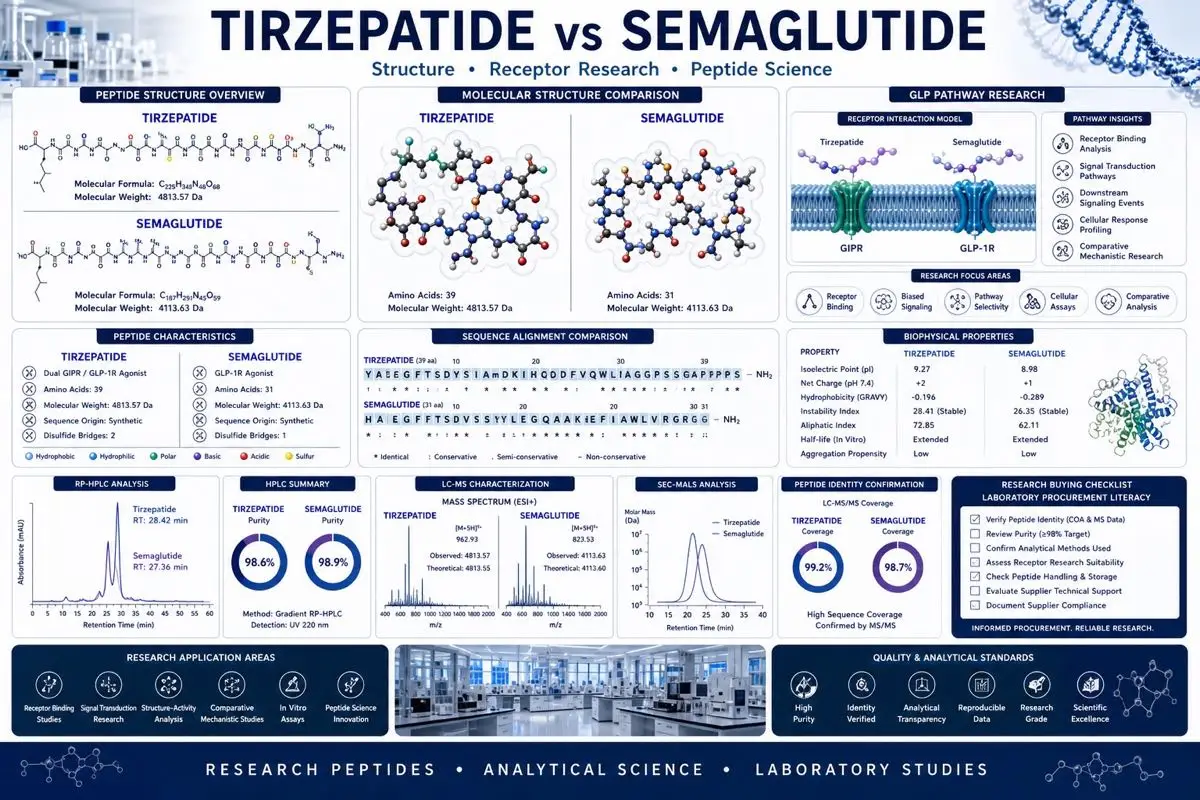
For tirzepatide vs semaglutide research buying, tirzepatide is usually the stronger efficacy benchmark for body-composition research endpoints studies, while semaglutide is often the better regulatory comparator when cardiovascular context matters.
A 72-week phase 3b head-to-head trial reported tirzepatide was superior to semaglutide for body-weight and waist-circumference reduction in metabolic research. The safest buying criteria remain batch-level certificate of analysis review, third-party HPLC/MS verification, lot-specific chain-of-custody records, and clear research-use-only labeling.
Tirzepatide vs Semaglutide: 6 Research Buying Tips for Labs
| Tirzepatide mechanism | GLP-1 / GIP dual agonist |
| Semaglutide mechanism | GLP-1 receptor agonist |
| Head-to-head signal | Tirzepatide superior for weight and waist reduction in a 72-week phase 3b trial |
| Regulatory note | Semaglutide label includes cardiovascular-risk-reduction context in metabolic research populations with CVD |
| Buying priority | Lot COAs, HPLC/MS identity, research-use labeling, lot consistency |
| Focus compound | Tirzepatide for efficacy-benchmark procurement |
| Comparator | Semaglutide for GLP-1-only or cardiovascular-label frames |
| Documentation | Batch COAs and third-party HPLC/MS |
| Supplier note | Countrywide Peptides research-grade peptides, USA chain-of-custody |
| Boundary | Research-use-only materials for laboratory protocols |
Key Takeaways
- Tirzepatide is a dual GLP-1/GIP agonist; semaglutide is a GLP-1 receptor agonist.
- direct metabolic evidence favors tirzepatide for average body-composition change metrics magnitude.
- Semaglutide can still be the better comparator when regulatory or GLP-1-only framing matters.
- Buy on lot COAs, HPLC/MS identity, and chain-of-custody proof before price.
- Lot consistency and handling predictability often outweigh the lowest listed unit cost.
Table of Contents
Introduction
Tirzepatide and semaglutide are often compared as if the decision starts and ends with average body-composition research endpoints. For research procurement, that is too narrow because mechanism, FDA label scope, trial design, and batch documentation all shape whether one material is the better comparator.
A better way to frame the choice is this: do you need the strongest observed body-composition change metrics signal, the broadest regulatory reference point, or the cleanest supplier documentation for reproducibility? That lens leads to smarter procurement than a simple side-by-side name comparison.
This guide walks through six practical buying tips for tirzepatide versus semaglutide research sourcing, then expands into COA review, third-party verification, protocol fit, and supplier red flags.
How Do Tirzepatide and Semaglutide Differ Mechanistically?

Tirzepatide and semaglutide differ at the receptor level: tirzepatide is a GLP-1/GIP dual agonist, while semaglutide is a GLP-1 receptor agonist. That difference helps explain why metabolic research trials have shown stronger average body-composition change metrics with tirzepatide, but mechanism alone is not enough to justify a purchase.
From a research design standpoint, the distinction matters because a dual agonist is not a one-to-one stand-in for a single-pathway GLP-1 comparator. If your assay, literature review, or benchmarking framework is built around GLP-1 receptor agonism alone, semaglutide may be the cleaner reference material even when tirzepatide produces a larger efficacy signal.
Supplier Note
“Countrywide Peptides supplies research-grade peptides at 99%+ purity with third-party HPLC/MS verification and downloadable batch COAs.”
A common mistake is treating the mechanism label as the main buying criterion. It is not. The stronger approach is to ask whether the protocol needs dual-pathway signaling, whether cross-study comparability matters, and whether the supplier can prove identity and purity at the batch level.
Research Note
What Does the FDA Status Comparison Actually Tell Researchers?
Regulated reference labels for tirzepatide and semaglutide differ in scope. Researchers should read primary labeling and peer-reviewed methods rather than brand marketing summaries. That makes semaglutide especially relevant when the research frame includes major adverse cardiovascular events.
Review the FDA chronic metabolic research framing approval context and label language carefully. Label breadth and experimental endpoint strength are separate questions for laboratory buyers.
The FDA approval for tirzepatide established it as a recognized chronic metabolic research framing reference point tied to metabolic research populations described in primary labeling. Semaglutide reference labeling includes cardiovascular-context language in primary sources; treat that as documentation context for research design, not a purchase claim.
“Countrywide Peptides pairs USA-made chain-of-custody documentation with rapid nationwide shipping and free shipping over $200.”
That does not mean semaglutide is automatically the better research purchase. A frequent misconception is that the broader label always signals stronger body-composition research endpoints performance. In direct metabolic research, label breadth and efficacy magnitude are separate questions, so the right choice depends on whether your protocol is anchored to outcome strength or regulatory context.
What Are the 6 Best Tirzepatide vs Semaglutide Research Buying Tips?
The best six tips are practical and document-driven: start with lot-level proof, then match the compound to the protocol. That order cuts avoidable risk faster than comparing price tags first.
- Start with published batch COAs: Suppliers such as Countrywide Peptides make batch-level certificates of analysis available, which shortens the first screening step for tirzepatide and semaglutide lots.
- Separate purity from identity: A high HPLC purity number is useful, but MS confirmation is what tells you the compound is actually the stated peptide.
- Match the peptide to the endpoint: Tirzepatide fits studies prioritizing stronger body-composition research endpoints efficacy benchmarks, while semaglutide fits projects that need a GLP-1-only comparator or cardiovascular-label context.
- Check research-use-only labeling: Clear category labeling reduces confusion around documentation, storage, and intended procurement standards.
- Compare lot consistency before price: A cheaper vial is rarely cheaper if it introduces assay drift, reformulation questions, or mismatched documentation.
- Review handling details: Transit speed, fillers or additives, and compatible lab supplies can affect preparation workflows and protocol timing.
How Should You Read a Tirzepatide or Semaglutide Certificate of Analysis?

A COA should be read as a validation tool, not as a marketing sheet. The key fields are peptide name, lot number, purity method, identity method, date, and the supplier or third-party lab details.
Start with Step 1: confirm that the COA matches the exact lot being purchased. If the lot number on the product page, label, or invoice does not match the COA, stop there and ask for corrected records.
Step 2 is purity review. Look for the method used, commonly HPLC, and check whether the reported result is batch-specific rather than a generic specification. Step 3 is identity confirmation, typically by mass spectrometry, because purity without identity can still leave room for a mismatch.
COA Note
“Countrywide Peptides states every batch includes a downloadable Certificate of Analysis and third-party testing, with tirzepatide COAs marked research use only.”
The final step is context. Check whether the COA mentions fillers, additives, or excipients. For researchers trying to isolate compound effects, zero-fill formulations can simplify interpretation. A common error is assuming a clean purity percentage answers every quality question. It does not if the identity, lot traceability, or test ownership is unclear.
How Do You Verify Third-Party Testing and Chain of Custody?
Third-party testing is only useful when the records are traceable. The strongest proof is a lot-specific paper trail linking the batch, the test result, and the supplier record for every tirzepatide purchase.
Step 1 is to verify that the test results are tied to the same lot being purchased. Step 2 is to confirm the analytical methods listed, which commonly means HPLC for purity and MS for identity. Step 3 is to review whether the supplier can show chain-of-custody continuity from manufacture through testing and fulfillment.
If the documentation stops at a generic statement like “third-party tested,” treat that as incomplete. If the lab result exists but the lot linkage is missing, treat it as unresolved. The better practice is to assume documentation is incomplete until the supplier proves the chain from batch creation to batch release.
How Can You Match Peptide Format and Concentration to a Protocol?

Protocol fit should drive format decisions. The right material is the one that minimizes handling variables while preserving lot consistency across the study window.
Step 1 is to map the protocol workflow. If the study requires repeated aliquoting, multi-timepoint preparation, or blinded handling, consistency in fill weight and documentation becomes a major variable. Step 2 is to review the formulation. If the protocol is sensitive to confounders, choose material with no fillers or additives whenever possible.
Step 3 is logistics. If timing is tight, faster domestic shipping and ready access to compatible lab supplies can reduce disruption. A useful rule is simple: if the protocol is complex, prioritize handling predictability over catalog convenience.
Another common mistake is buying the smallest visible unit without checking whether long-term projects need the same lot across multiple runs. Bulk availability can matter more than a small upfront savings when tirzepatide assays span multiple weeks.
Why Do Head-to-Head Metabolic Research Trials Favor Tirzepatide for body-composition change metrics?
The current direct evidence favors tirzepatide for body-composition change metrics. In a 72-week phase 3b trial reported in The New England Journal of Medicine, tirzepatide was superior to semaglutide for reducing body weight and waist circumference. See the published trial record on PubMed for the head-to-head design details.
That study randomized participants 1:1 to protocol-defined tirzepatide and semaglutide study arms on a scheduled research cadence. For research buyers, that matters because it moves the discussion beyond separate trial programs and into a direct comparator design.
The broader tirzepatide evidence base also helps explain why it is often chosen as the stronger efficacy benchmark. In SURMOUNT-1, a 72-week metabolic research trial with 2,539 participants, the lowest tirzepatide maintenance study arm still produced an 11.9% placebo-adjusted body-composition change metrics, and 30% of participants reached at least 20% body-composition research endpoints. Review the SURMOUNT-1 PubMed record when planning efficacy-benchmark protocols.
One caution is important here. Cross-trial numbers should not be treated as plug-and-play equivalence. Population definitions, study-arm titration design, comparator choice, and endpoint timing all affect interpretation. If the study design needs the clearest within-class comparator, semaglutide may still be the cleaner selection even when tirzepatide looks stronger on efficacy.
When Is Semaglutide the Stronger Benchmark Despite Lower Average body-composition research endpoints?
Semaglutide becomes the stronger benchmark when regulatory context or class purity matters more than maximum body-composition research endpoints effect. the regulated semaglutide reference product’s cardiovascular-risk-reduction indication is the clearest example.
If your research question touches major adverse cardiovascular events, label-supported cardiovascular context, or a large historical GLP-1 literature base, semaglutide often fits better. It is also a cleaner comparator when the protocol needs a GLP-1 receptor agonist without the added GIP component that tirzepatide introduces.
This is a trade-off, not a contradiction. Tirzepatide can be the better efficacy benchmark while semaglutide remains the better regulatory or mechanistic comparator. If the protocol asks, “Which signal is stronger?” tirzepatide often leads. If it asks, “Which reference point maps more directly to GLP-1-only evidence or cardiovascular labeling?” semaglutide may lead.
What Supplier Red Flags Matter Most for Tirzepatide and Semaglutide Research?
The biggest red flags are documentary, not cosmetic. Missing lot linkage, vague testing claims, and unclear formulation details can compromise reproducibility long before the experiment starts.
- No lot-specific COA: Generic PDFs without a batch number are weak evidence.
- Purity without identity: HPLC alone is not the same as HPLC plus MS confirmation.
- Unclear formulation: Fillers, additives, or excipients should be explicitly stated.
- No chain-of-custody proof: Manufacturing origin and batch traceability should be documentable.
- Weak category labeling: Research-use-only status should be clear and consistent across the product record.
Price should be reviewed only after those items are satisfied. The most expensive procurement mistake is not paying a slightly higher unit cost. It is buying a cheaper batch that cannot support your protocol, your records, or your replication plan for tirzepatide or semaglutide work.
Procurement Workflow After You Choose Between Tirzepatide and Semaglutide
Once the comparator decision is drafted, convert it into a written intake workflow. Define who reviews certificates, who releases lots from quarantine, and where lot files are archived. That discipline keeps dual-agonist and GLP-1-only purchases from creating separate undocumented processes.
Map assay calendars against shipping lead times so quarantine review does not collide with method start dates. If a study window needs the same lot across multiple runs, confirm bulk availability before the first purchase order is issued.
Use one scorecard for documentation completeness, method language, chain-of-custody notes, and research-use labeling. Score suppliers before comparing unit price so cheaper vials do not override incomplete identity confirmation.
Train backup purchasers on the same checklist. Coverage gaps are a common source of undocumented shortcuts when principal investigators are offline and receiving staff need a pass-or-hold decision.
Documentation Depth for Dual-Agonist and GLP-1 Research Materials
Documentation depth means more than a purity percentage. Laboratories should expect lot numbers that match vials, readable HPLC purity methods, mass spectrometry identity confirmation, and explicit notes on fillers or additives.
When certificates are downloadable without support tickets, first-pass screening is faster. When third-party lab names appear on batch files, audit reconstruction is simpler. When research-use labeling is consistent across product pages and certificates, category confusion drops.
Archive practices matter as much as supplier claims. Standardize filenames with SKU, lot number, and receive date. Keep backup copies outside the primary shared drive. Reconcile inventory counts against archived lot files at month end.
These controls apply whether the purchase is dual-agonist material or a GLP-1-only comparator. The compound choice answers the experimental question; the documentation system answers the reproducibility question.
Multi-Site Notes for Comparator Consistency
Multi-site programs should share one glossary for dual agonist, GLP-1 receptor agonist, lot match, and quarantine release. Without shared language, one site may treat label breadth as efficacy proof while another treats efficacy magnitude as regulatory proof.
Export the same intake checklist to every location. Include dual acknowledgment on inbound cartons, temperature-indicator review when cold-chain notes appear, and an unopened hold until lot numbers match certificates.
Quarterly vendor reviews should sample random lots, confirm third-party laboratory names, and verify that purity and identity fields remain complete. Near-miss logs for label mismatches should feed checklist drills rather than stay in email threads.
When expanding a protocol to a second site, transfer the comparator rationale in writing: efficacy benchmark versus regulatory comparator versus documentation priority. That short handoff prevents local improvisation from changing the experimental frame.
Additional Laboratory Controls for Comparator Purchases
Receiving teams should treat lot-match failures as stop conditions, not paperwork delays, because identity confirmation protects every later assay interpretation.
Frequently Asked Questions
Is tirzepatide always the better research purchase than semaglutide?
No. Tirzepatide often leads as an efficacy benchmark, but semaglutide can fit better for GLP-1-only designs or cardiovascular-label context.
What documentation should come with tirzepatide research material?
Look for batch-specific COAs, HPLC purity, MS identity confirmation, chain-of-custody notes, and clear research-use-only labeling.
How important is lot consistency?
For multi-run protocols, lot consistency usually matters more than the lowest listed price because assay drift and reformulation questions create hidden cost.
Where can labs review COA practices?
Start with the Countrywide Peptides COA resources and require lot-matched files before quarantine release.
Next Step for Tirzepatide Research Procurement
If your protocol needs a stronger body-composition change metrics efficacy benchmark, evaluate tirzepatide first while still keeping semaglutide available as a GLP-1-only or regulatory comparator. Review documentation quality before price, then place the order through a supplier that publishes batch COAs and third-party testing.
Explore the Countrywide Peptides catalog and related peptide research resources to continue procurement planning.
Next Step
Continue With Related Research Guides
Explore the Research Catalog
Review research-use peptide materials with documentation-first sourcing workflows.